
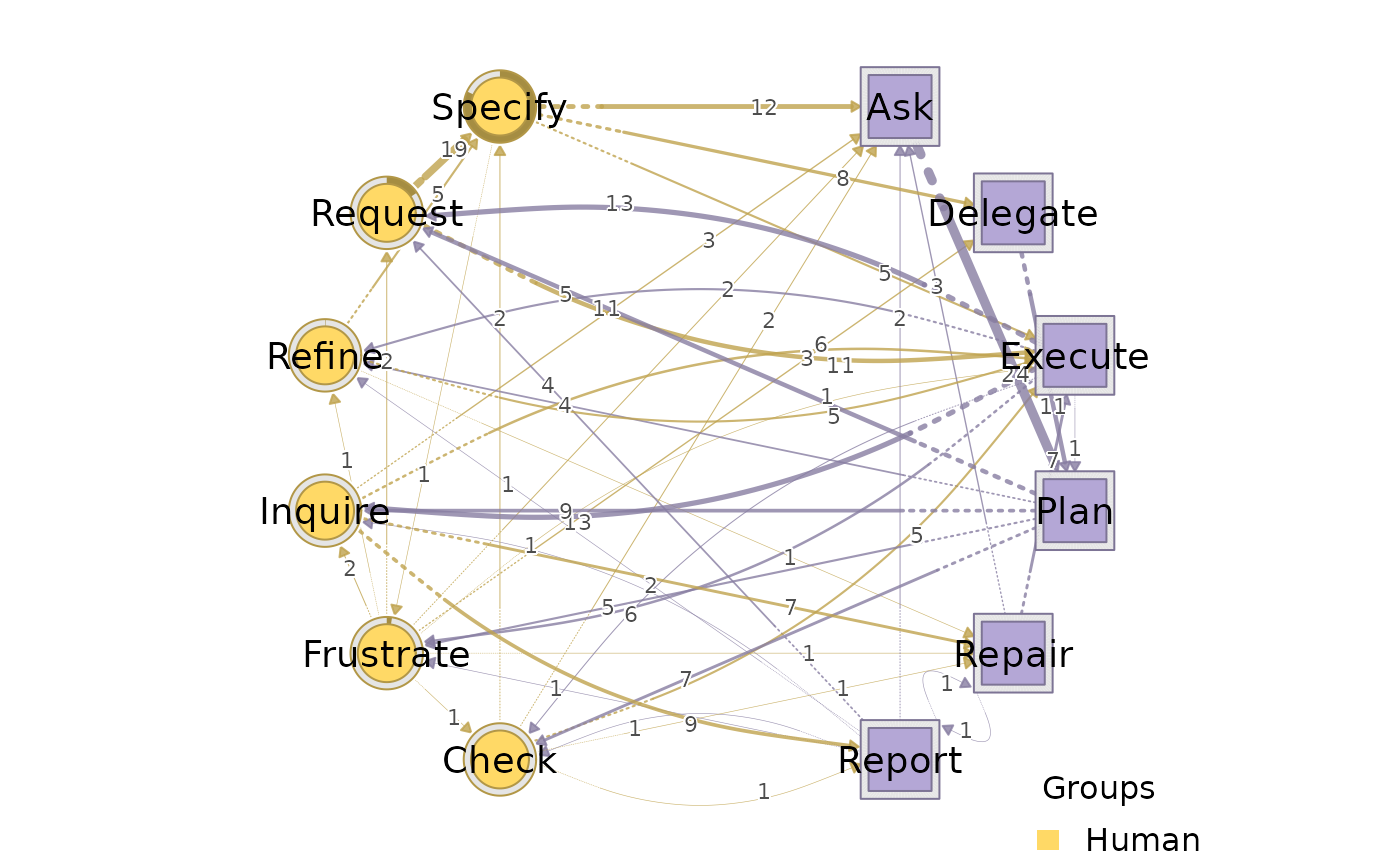
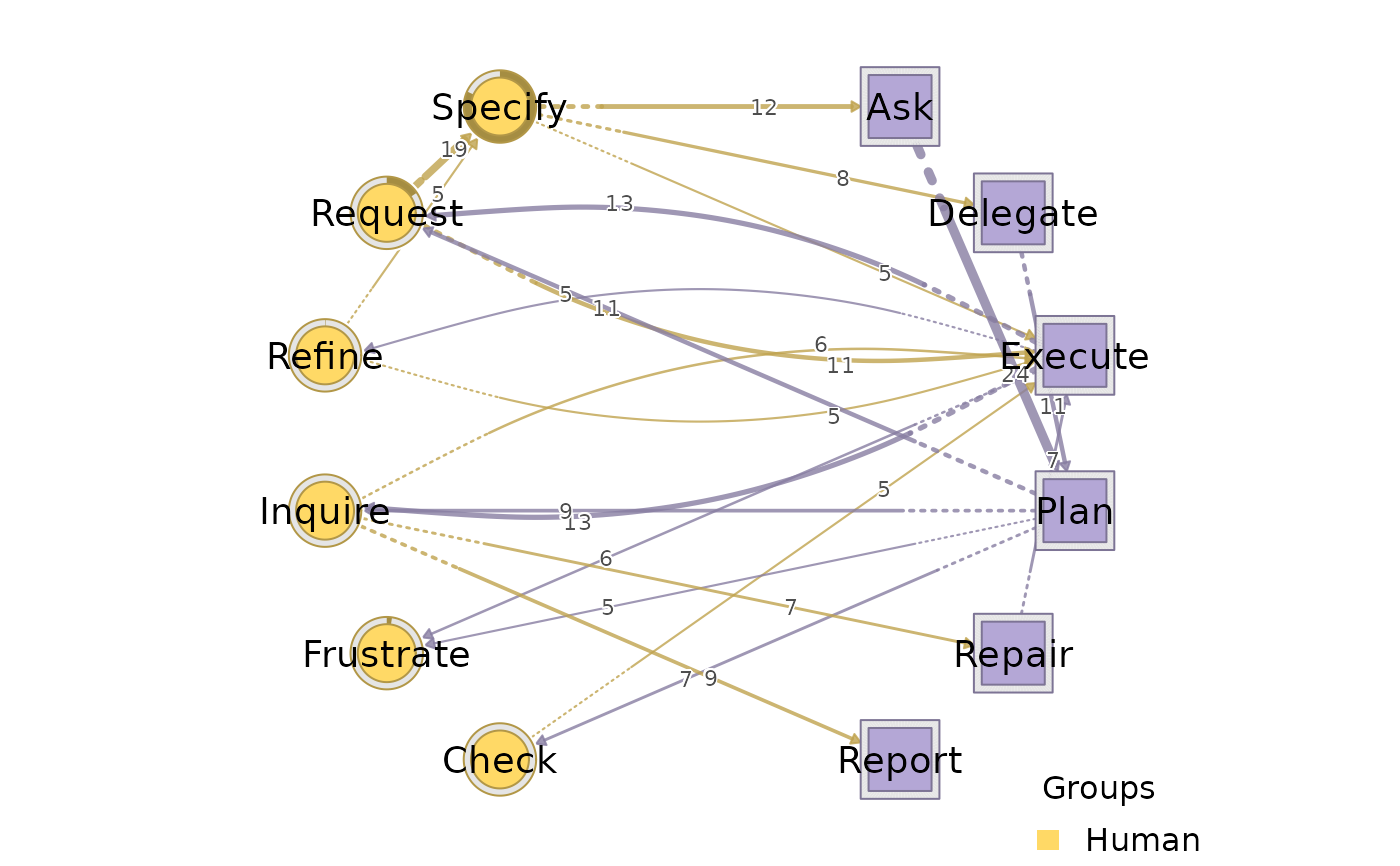
Computes edge_betweenness_htna() and renders it with the htna
actor styling (multi-actor circular layout, htna_palette node
colours, actor legend). Edges are scaled by their betweenness
score, so the most-traveled shortest-path edges stand out.
Arguments
- x
An htna network from
build_htna()or, equivalently, the result ofedge_betweenness_htna().- directed, invert
Forwarded to
edge_betweenness_htna()whenxis a plain htna network. Ignored whenxalready inherits fromhtna_edge_betweenness.- ...
Forwarded to
plot_htna()(e.g.minimum,layout,group_colors).
Value
The value returned by plot_htna() (invisibly).
Examples
# \donttest{
data(human_ai)
net <- build_htna(human_ai, actor_type = "actor_type")
#> Warning: A network with one long sequence is not recommended and can't be validated using bootstrap and other confirmatory testings.
#> Metadata aggregated per session: ties resolved by first occurrence in 'session_date' (1 sessions), 'cluster' (42 sessions), 'actor_type' (24 sessions)
plot_edge_betweenness_htna(net)
 plot_edge_betweenness_htna(net, minimum = 5)
 # }
# }