htna is an R package for Heterogeneous Transition Network Analysis (HTNA) that models processes or interactions between a mix two or more actor groups (e.g. Human and AI) as a single network. HTNA builds on the traditions of Transition Network Analysis (TNA) and Co-occurrence Network Analysis (CNA) and maintains the rigor of either method.
The package provides a focused API on top of the Nestimate estimation engine and the cograph rendering engine: build a network over the combined sequence while preserving the actor partition, so downstream bootstrap, permutation, reliability, centrality, and plotting functions treat each actor’s codes as a distinct node group.
Installation
Install the released version of htna from CRAN:
install.packages("htna")Or the development version from GitHub:
# install.packages("devtools")
devtools::install_github("sonsoleslp/htna")
Example
Load the example data shipped with htna:
data(human_ai)Build a heterogeneous transition network
build_htna() takes a data frame with a column indicating the actor type, combines the sequences, estimates transition probabilities, and stores the actor partition on the resulting network:
net <- build_htna(human_ai, actor_type = "actor_type")Plot the network
plot_htna() auto-detects the actor groups and renders them with distinct colours:
plot_htna(net, threshold = 0.05, layout = "circular")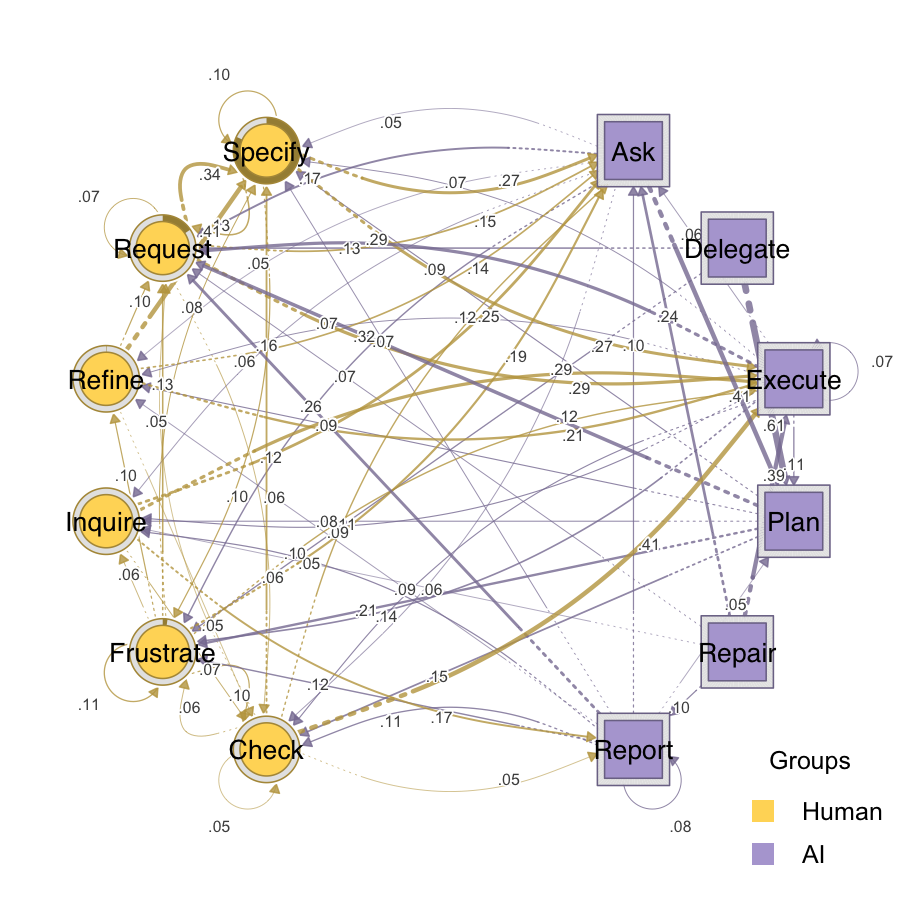
Extract path patterns
By default extract_meta_paths() enumerates concrete state-level patterns and tags each row with the type-level template it instantiates:
extract_meta_paths(net)
#> Patterns (state-level) over 429 sequences
#> Rows: 5445 | Lengths: 2, 3, 4 | Gaps: 0
#>              schema  meta_schema length gap count n_seq support frequency lift
#>    Request->Specify Human->Human      2   0  1042   402   0.937     0.055 2.27
#>           Ask->Plan       AI->AI      2   0   964   346   0.807     0.051 4.87
#>    Execute->Request    AI->Human      2   0   921   269   0.627     0.049 1.80
#>    Request->Execute    Human->AI      2   0   904   299   0.697     0.048 1.77
#>    Specify->Execute    Human->AI      2   0   796   261   0.608     0.042 1.66
#>        Specify->Ask    Human->AI      2   0   784   292   0.681     0.041 2.20
#>      Check->Execute    Human->AI      2   0   534   243   0.566     0.028 2.50
#>       Plan->Request    AI->Human      2   0   503   268   0.625     0.027 1.98
#>        Request->Ask    Human->AI      2   0   459   222   0.517     0.024 1.21
#>  Execute->Frustrate    AI->Human      2   0   451   230   0.536     0.024 1.50
#> ... (5435 more)
Filter to concrete instances of a type-level template. Schema parts can mix type names, concrete codes, and *:
extract_meta_paths(net, schema = "Human->AI->Human")
#> State-level instances of schema 'Human->AI->Human' over 429 sequences
#> Rows: 163 | Lengths: 3 | Gaps: 0
#>                       schema      meta_schema length gap count n_seq support
#>    Request->Execute->Request Human->AI->Human      3   0   401   194   0.452
#>    Specify->Execute->Request Human->AI->Human      3   0   176   107   0.249
#>        Request->Ask->Request Human->AI->Human      3   0   130    91   0.212
#>      Check->Execute->Request Human->AI->Human      3   0   123    96   0.224
#>        Specify->Ask->Request Human->AI->Human      3   0   120    84   0.196
#>  Specify->Execute->Frustrate Human->AI->Human      3   0   114    88   0.205
#>  Request->Execute->Frustrate Human->AI->Human      3   0   106    88   0.205
#>    Request->Execute->Inquire Human->AI->Human      3   0    97    76   0.177
#>      Specify->Ask->Frustrate Human->AI->Human      3   0    86    70   0.163
#>    Inquire->Execute->Request Human->AI->Human      3   0    73    52   0.121
#>  frequency lift
#>      0.112 5.00
#>      0.049 2.33
#>      0.036 2.19
#>      0.034 3.67
#>      0.033 2.15
#>      0.032 2.57
#>      0.030 2.24
#>      0.027 4.40
#>      0.024 2.61
#>      0.020 3.31
#> ... (153 more)
extract_meta_paths(net, schema = "Human->Ask->*")
#> State-level instances of schema 'Human->Ask->*' over 429 sequences
#> Rows: 63 | Lengths: 3 | Gaps: 0
#>                   schema      meta_schema length gap count n_seq support
#>       Specify->Ask->Plan    Human->AI->AI      3   0   340   197   0.459
#>     Frustrate->Ask->Plan    Human->AI->AI      3   0   214   187   0.436
#>       Request->Ask->Plan    Human->AI->AI      3   0   139   106   0.247
#>    Request->Ask->Request Human->AI->Human      3   0   130    91   0.212
#>    Specify->Ask->Request Human->AI->Human      3   0   120    84   0.196
#>  Specify->Ask->Frustrate Human->AI->Human      3   0    86    70   0.163
#>       Inquire->Ask->Plan    Human->AI->AI      3   0    53    45   0.105
#>        Refine->Ask->Plan    Human->AI->AI      3   0    52    46   0.107
#>  Request->Ask->Frustrate Human->AI->Human      3   0    50    44   0.103
#>    Specify->Ask->Specify Human->AI->Human      3   0    49    41   0.096
#>  frequency  lift
#>      0.170 11.65
#>      0.107 11.71
#>      0.070  4.48
#>      0.065  2.19
#>      0.060  2.15
#>      0.043  2.61
#>      0.027  6.22
#>      0.026  6.57
#>      0.025  1.43
#>      0.025  0.93
#> ... (53 more)
Pass level = "type" for the type-level meta-path summary:
extract_meta_paths(net, level = "type")
#> Meta-paths (type-level) over 429 sequences
#> Rows: 28 | Lengths: 2, 3, 4 | Gaps: 0
#>            schema length gap count n_seq support frequency lift
#>         Human->AI      2   0  5970   428   0.998     0.316 1.28
#>         AI->Human      2   0  5693   424   0.988     0.301 1.22
#>      Human->Human      2   0  4674   422   0.984     0.247 0.79
#>            AI->AI      2   0  2581   403   0.939     0.136 0.70
#>  Human->AI->Human      3   0  3593   402   0.937     0.194 1.41
#>  Human->Human->AI      3   0  3172   422   0.984     0.172 1.25
#>  AI->Human->Human      3   0  2828   403   0.939     0.153 1.11
#>     AI->Human->AI      3   0  2744   383   0.893     0.148 1.36
#>     Human->AI->AI      3   0  2189   403   0.939     0.118 1.09
#>     AI->AI->Human      3   0  2100   397   0.925     0.114 1.04
#> ... (18 more)
Related research
- López-Pernas, S., Misiejuk, K., Tikka, S., & Saqr, M. (2026). Role Dynamics in Student–AI Collaboration: A Heterogeneous Transition Network Analysis Approach. Innovations in Analytics of Learning Dynamics: Proceedings of the 1st Workshop on Transition Network Analysis (TNA). https://dx.doi.org/10.2139/ssrn.6082190
- López-Pernas, S., Misiejuk, K., & Saqr, M. (2026). How AI ‐generated feedback hinders or helps learning: A heterogeneous TNA study of learning dynamics. Journal of Computer Assisted Learning, 42(4), e70285. https://doi.org/10.1002/jcal.70285
- Rinja, D., Oliveira, E. A., López-Pernas, S., Saqr, M., Specht, M., & Misiejuk, K. (2027). Unpacking vibe coding: Help-seeking processes in student-AI interactions while programming. Proceedings of Artificial Intelligence in Education: 27th International Conference, AIED 2026. Springer Nature Switzerland. https://doi.org/10.1007/978-3-032-29763-1_35